
Episode 39: The Private Equity Playbook — Philz Coffee
Coffee, Silicon Valley, and… George W. Bush's former roommate? In this episode of Art of Citizenry Podcast, host Manpreet Kaur Kalra is joined by long-time collaborator Anna Canning as they kick off a new series on private equity by tracing what happens when big finance meets something as everyday as your morning cup of coffee.
Private Equity, Philz Coffee, and Employee Stocks
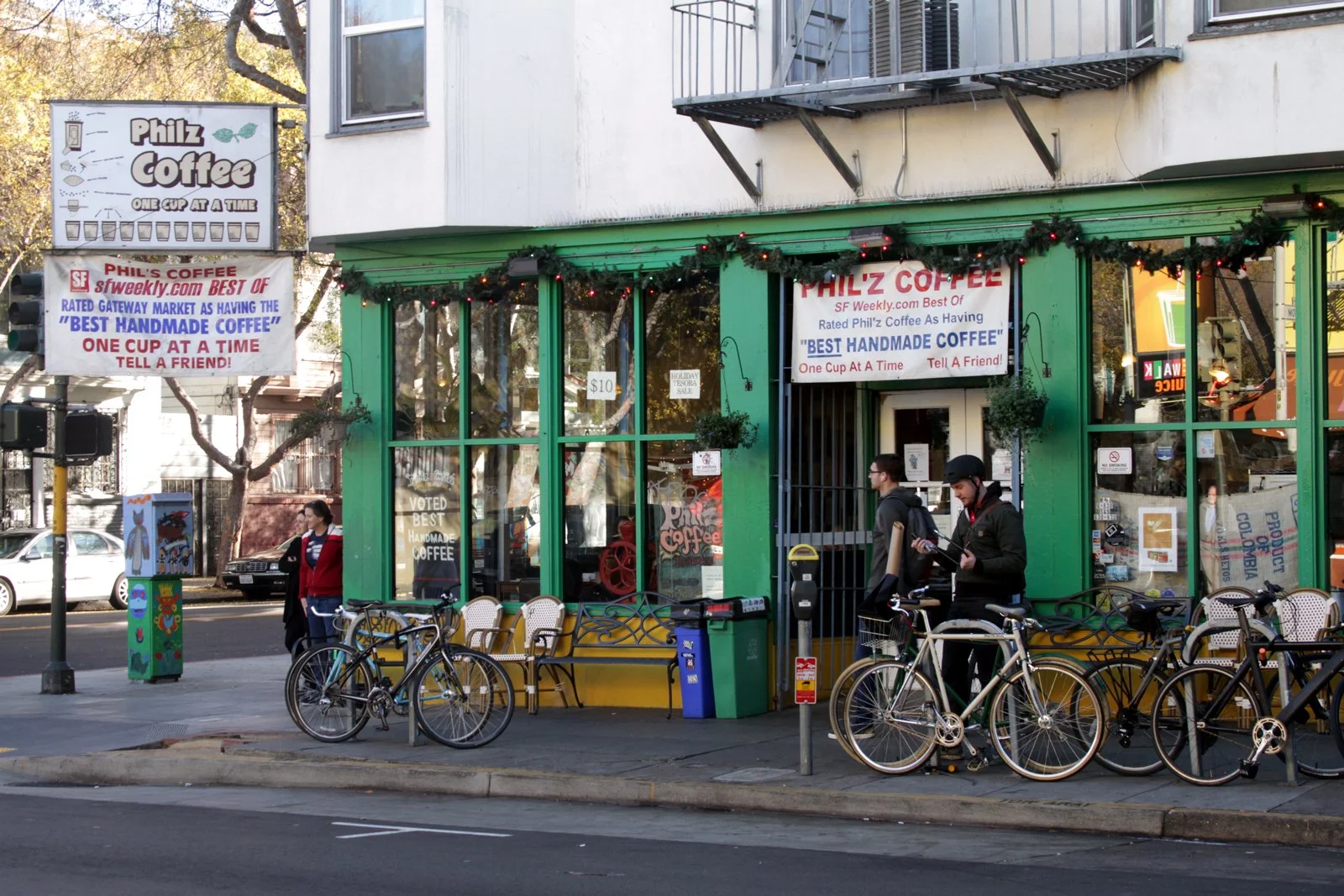
The first Philz Coffee in San Francisco. Photo courtesy of Mission Local (check them out!) and taken by Courtney Quirin.
Philz Coffee made headlines earlier this year when the iconic San Francisco coffee company got bought by private equity firm Freeman Spogli in a deal that cancelled out all employee stock options. Together, Manpreet and Anna dig into what happened, breaking down the complex financial maneuvers and unpacking how this conclusion was both unexpected and not all that surprising.
TL;DR So much of what we see in our daily lives, the rising cost of housing, the quality of healthcare, even how our clothes are getting crappier, is all shaped by private equity. — Anna Canning
Starting with the basics — what private equity actually is and how it works, they unpack how workers’ stock was wiped out in a deal that will still pay out executives and investors. It’s an explanation that gets into the difference between common and preferred stocks, liquidation preferences, debt structures, who gets paid first, and how these seemingly abstract financial tools translate into real losses for workers and communities. Along the way, they trace Philz’s arc from beloved third-wave coffee darling of Silicon Valley to a company reshaped by venture capital, private equity, union-busting tactics, and store closures.
Private equity’s focus on quick, outsized profits is exactly what makes it so harmful to communities. It’s designed to extract value fast, which is great for investors, but devastating for workers, consumers, and communities left to absorb the fallout.
— Manpreet Kaur Kalra
Join us as we look at corporate consolidation in coffee and beyond: Nestlé’s and JAB’s coffee empires, the pressure on small ethical roasters, historic low coffee prices for farmers, and how firms like Freeman Spogli have been quietly reshaping everything from grocery chains to farmers’ livelihoods. Manpreet and Anna connect the dots between colonialism, capitalism, and financialization, showing how risk is repeatedly pushed down onto workers (and farmers) while profits are siphoned off at the top.
Private equity firms are really good at gambling with other people's money. Just like with a casino, the house always wins, and they have been really good at rigging the system so the bosses on top keep winning.
— Anna Canning
📌 Art of Citizenry is proudly independent. Support us as we critically explore, challenge, and unravel mainstream narratives by empowering listeners with accessible, nuanced perspectives.
Make a one-time contribution via Paypal: visit.artofcitizenry.com/paypal
In this episode, we explore:
What private equity is and how “leveraged buyouts” and high-risk financial engineering shape our daily lives
The hierarchy of who gets paid when investors are involved and what Philz’s decision to cancel worker stock tells us about whose investments really matter
How consolidation in coffee offers insights into the broader patterns of the global economy where consolidation has become the name of the game
The people, let’s be real…men behind Freeman Spogli, the firm’s origins, and ties to U.S. politics.
Why transparency, journalism, and informed communities are essential for pushing back on corporate impunity
Why these conversations are important: Private equity is this shadowy force, moving billions of dollars behind closed doors. But those decisions ripple out into our communities in ways that we just cannot ignore. — Manpreet Kaur Kalra
Key Takeaways
Financial tools like leveraged buyouts, preferred stock, and liquidation preferences are designed to protect wealthy investors, not workers.
Philz Coffee’s story shows how workers can be encouraged to “think like owners” and invest their own money, only to be written out of the payoff when it counts.
Corporate consolidation funnels power and profit upwards, while risk and instability are pushed onto those who can least afford it: workers.
Independent, local journalism is often the only reason we even hear about these stories, and public scrutiny can still force small concessions.
Resources & Mentions
Mission Local: San Francisco–based independent outlet whose reporting on Philz Coffee, worker organizing, and the stock cancellation anchors much of this episode’s story.
Philz Coffee close to closing deal to sell to private equity firm for $145 million
Philz Coffee completes $145M sale to private equity firm, leaves tips for baristas
Sprudge – Coffee trade publication whose coverage of the Philz deal (and their description of Freeman Spogli) sent Anna down several rabbit holes:
Support the Podcast
Art of Citizenry is 100% listener-supported. Every contribution helps us continue producing research-intensive episodes and paying our small but mighty team. If this episode resonates with you, consider supporting our work:
💸 One-time contribution: Paypal
✍️ Subscribe to us on Substack & upgrade your account to paid
💌 Monthly support: Patreon
Thank You for Listening
Please subscribe and leave a five-star review for Art of Citizenry wherever you listen to podcasts. Also, follow along and share your thoughts on Substack - artofcitizenry.substack.com.